

Dizzy Panic!
A Dizzy puzzle spin-off featuring falling shapes and crushing machinery, developed by Big Red Software from a concept by the Twins.
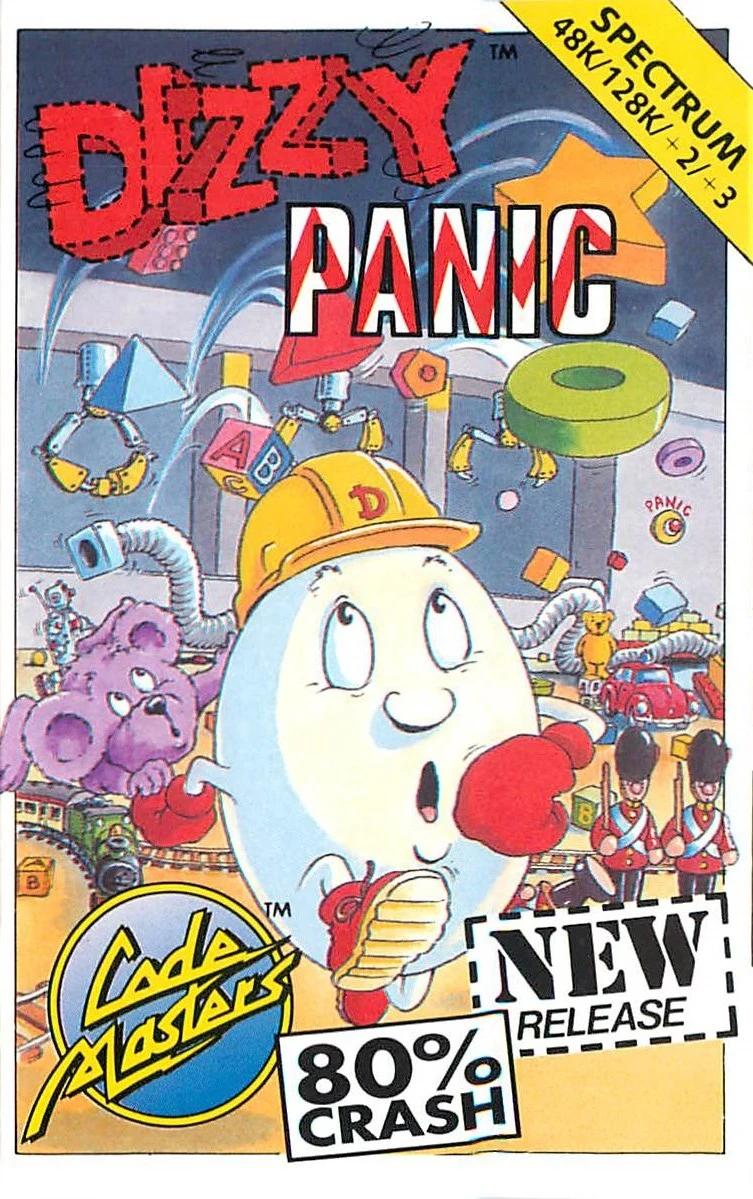
Image credits and source
Original cover / promotional artwork
Credit: Codemasters — artwork belongs to its respective rights holders
Source: The Oliver Twins archive
Game at a glance
- Status
- Classic
- Released
- 1991
- Platforms
- Amstrad CPC, ZX Spectrum, Commodore 64, Master System, Game Gear
- Genres
- Puzzle
- Developer
- Big Red Software; The Oliver Twins (concept/design)
- Publisher
- Codemasters
Development and publication
Development: Big Red Software; The Oliver Twins (concept/design). Publication: Codemasters.
The Oliver Twins created Dizzy and contributed the concept, design or oversight identified above. Programming and conversions are credited separately.
Making the game
Bizarrely this game came from a dream! Andrew and I had got our Nintendo GameBoys, as did every gamer back in 1990, and it came with Tetris which was the ideal game for the system. It was extremely addictive and we found that fascinating since it’s graphics were so crude and the gameplay so simplistic. Obviously that got us thinking that perhaps we could do a Dizzy puzzle game, on paper that made logical sense. Dizzy was extremely popular and it wouldn’t compete against any of the other Dizzy games. The problem was thinking of a puzzle game and how to include Dizzy.
The solution came in a dream, yes really! I, Philip, had been mulling this over so much that one night I imagined playing a game running Dizzy back and forth dropping shapes down chutes. I woke up and went to write it up. Sadly as I was writing and drawing it up, it seemed the idea was badly flawed, that’s the problem with dreams! Why was Dizzy dropping shapes, where were they coming from, where were they going? I figured these falling shapes needed sorting and came up with the idea of a conveyor belt, but obviously that meant the player had to control this, which meant there was no need for him to be running back and forth at the top of the screen.
I modified the design and showed it to Paul Ranson, owner of Big Red Software, the studio writing some of the Dizzy adventure games since we’d now moved over to the NES. He liked the idea and could see it was easy to code, create graphics for and would likely sell well.
Paul decided to write it himself and did a great job, but once it was playable it was quickly evident that it lacked that addictive magic required for a great puzzle game. We tinkered with the rules and speeds but decided there wasn't much more we could do. It played quite well, it was very nicely presented so we decided we should ship it.
The game got some decent reviews and sold quite well, but we thought about it a lot afterwards trying to work out how to add that element of addictiveness to make a great puzzle game and would later try again with Panic! Dizzy on the NES.
The console follow-up: Panic! Dizzy
Having created Dizzy Panic on the home computers, we were left feeling it could have, and should have, been so much more addictive, but the only solution was to start from scratch.
So the NES game borrowed the name, flipping the order to Panic! Dizzy, and the idea of matching shapes in columns, but nothing else. We managed to re-introduce the original concept of Dizzy running back and forth, but this time at the bottom of the screen, instead of the conveyor belt. This all made a lot more sense and looked better. Then we had to come up with shapes and rules, and we came up with quite a few. On paper, it was difficult to tell what would work best, so we decided we’d put the best 5 in to give real value for money. It was also a way to hopefully ensure that some would work really well if some didn’t.
As it turns out, 2 worked really well - Match More (Shape Shifter) & Dizzy Dice - they both had that special addictive quality, whilst the other 3 added some gameplay and variety. Sadly the game wasn’t released at the time and was released 26 years later thanks to a Kickstarter campaign.
However we did convert the game in ‘93 to the SEGA Master System, Game Gear and MegaDrive, but just kept the best 3 games. It was included as 1 of the 3 games in the last release we had with Codemasters - the Excellent Dizzy Collection. Sadly our relationship was already broken by this point and they decided to duplicate only 5,000 on Master System and Game Gear making them extremely rare. The Megadrive version wasn’t released - especially sad, since it was the last game I wrote (Philip).