


Cavey
A BBC Micro arcade adventure starring a caveman, built around the Twins' early experiments with fast animated sprites.
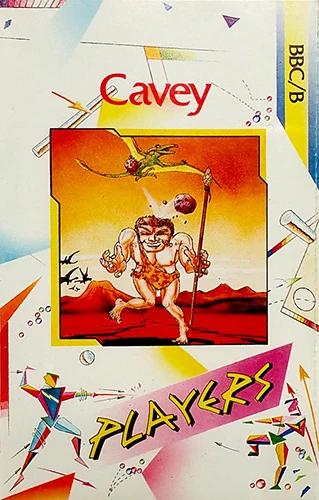
Image credits and source
Original cover / promotional artwork
Credit: Players — artwork belongs to its respective rights holders
Source: The Oliver Twins archive
Game at a glance
- Status
- Classic
- Released
- 1986
- Platforms
- BBC Micro
- Genres
- Platform
- Developer
- The Oliver Twins (original development)
- Publisher
- Players
Development and publication
Development: The Oliver Twins (original development). Publication: Players.
The named development credit refers to the original or specifically identified version. Other ports and later re-releases may have different development teams.
Making the game
Having learnt 6502 assembler during the production of Easy Art we realised it’s obvious speed and power for games and thought that we were now ready to write an arcade-style game. We didn’t want to be too ambitious with our first “machine code” game and came up with the idea doing a game like Galaga (think advanced Space invaders if you are not familiar with it), but rather than it being set in space, we’d set ours in a prehistoric world where the player controlled a cave man trapped in a valley inhabited by Pterodactyls. They’d swoop and drop rocks on Cavey who was armed with a number of spears.
We drew the sprites on graph paper and converted them to hex codes, which was the common way to get graphics into games in those days, but was very time-consuming. We came up with some fairly good code for the game. On sending it to Acornsoft for publication, they asked us to speed up the game, and further optimise it so it could run on the lower speed Acorn Electron (a really bad idea making it run at half the speed of the BBC Micro!). Sadly in the time it took for them to request this we accidentally lost the assembler source code. We ended up having to ‘hack’ the code and thought the best speed optimisations would come from rewriting the sprite routine. Rather than calculating the screen memory coordinates real-time, we changed it to use a pre-calculated a lookup table instead. The speed increase was incredible, to the point we had to add a few instructions to slow it down to make it playable.
Sadly by the time we returned the game to them, they changed their minds and decided not to publish it, and it was eventually published by Players at a budget price 2 years later!
The name was inspired by the nickname from one of the cartoons we were watching at the time – Captain Caveman and the Teen Angels.